
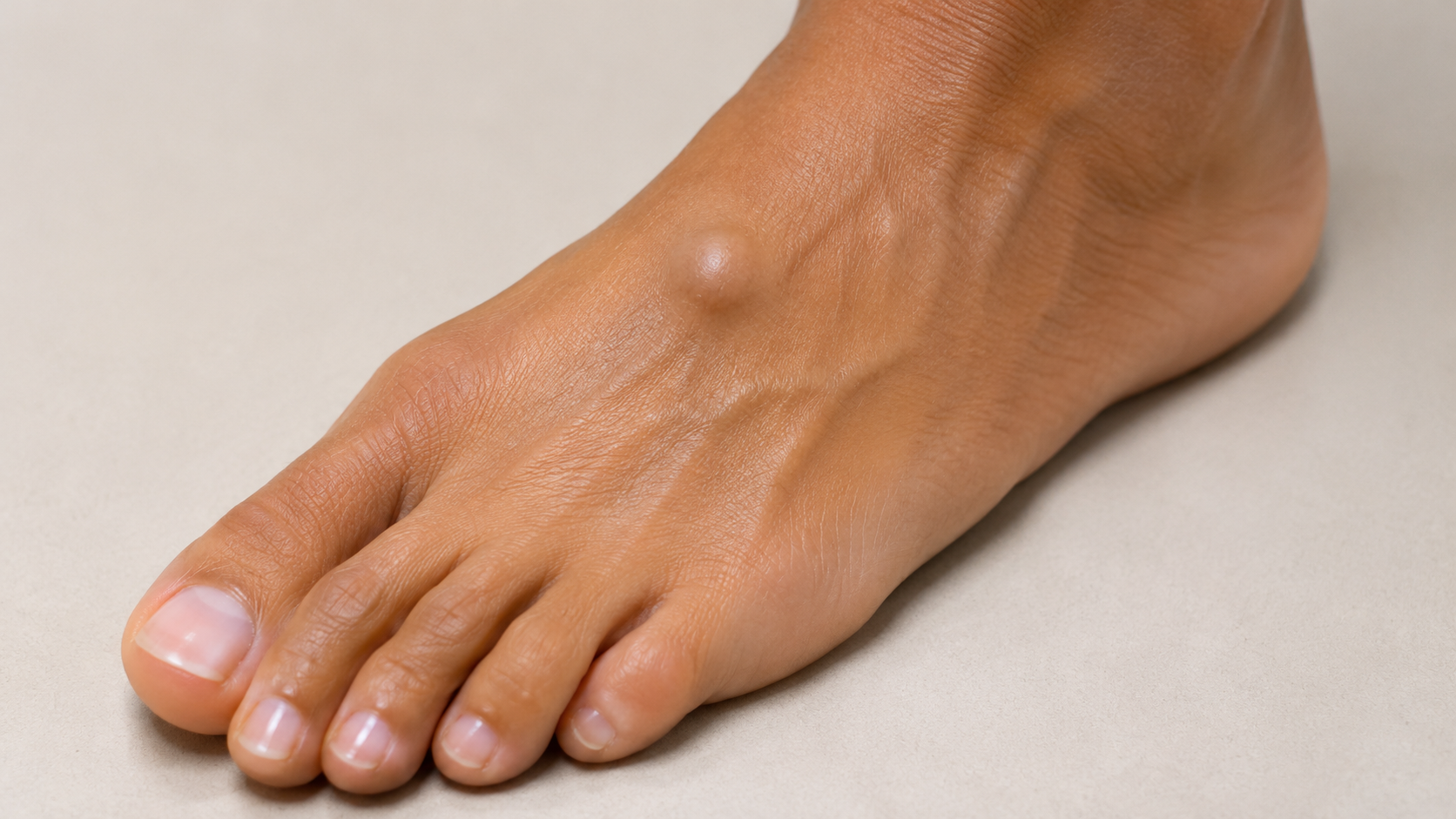
What Is That Lump on Top of My Foot? Common Causes and Treatment
Have you noticed a bump or lump on the top of your foot? Maybe it appeared suddenly, has been growing slowly, or becomes uncomfortable when you wear shoes.
Finding an unfamiliar lump can be concerning, especially when you’re unsure what caused it.
Fortunately, many lumps on the top of the foot are benign (noncancerous). One common cause is a ganglion cyst, a fluid-filled sac that develops near a joint or tendon. However, arthritis, bone spurs, and other conditions can also cause bumps or swelling in this area.
Understanding the possible causes of a lump on top of your foot can help you recognize when it’s time to see a podiatrist.
What Causes a Lump on Top of the Foot?
The top of your foot contains bones, joints, tendons, nerves, and soft tissues that help support movement.
A lump may develop when one of these structures becomes enlarged, inflamed, or affected by an underlying condition.
Common causes include:
- Ganglion cysts
- Bone spurs
- Arthritis
- Bursitis
- Lipomas (benign fatty growths)
- Other soft tissue masses
The lump’s location, size, firmness, and whether it causes pain can provide clues about the underlying cause.
However, appearance alone is not always enough to determine what a lump is.
Ganglion Cysts: A Common Cause of Lumps on Top of the Foot
A ganglion cyst is a fluid-filled lump that develops near a joint or tendon sheath.
These cysts contain a thick, jelly-like fluid and can vary in size.
Ganglion cysts commonly develop on the top of the foot, where they may become noticeable beneath the skin.
Symptoms may include:
- A round or oval bump on top of the foot
- A lump that feels soft, rubbery, or firm
- Changes in size over time
- Discomfort when shoes press against the area
- Tingling or numbness if the cyst presses on a nearby nerve
Some ganglion cysts cause no pain at all.
Others become uncomfortable because of their location, particularly when footwear places pressure on the lump.
Can a Ganglion Cyst Go Away on Its Own?
Yes. Some ganglion cysts shrink or disappear without treatment.
However, others may persist, change in size, or return after disappearing.
If a cyst is painless and does not interfere with daily activities, a podiatrist may recommend monitoring it.
Persistent, painful, or changing lumps should be evaluated to confirm the diagnosis and determine whether treatment is needed.
Bone Spurs on Top of the Foot
A bone spur is an extra growth of bone that may develop near a joint.
Bone spurs can form as a result of arthritis, joint stress, or other changes in the foot.
Unlike a ganglion cyst, which contains fluid, a bone spur is a solid bony growth.
Symptoms may include:
- A hard bump on top of the foot
- Pain when shoes press against the area
- Stiffness in nearby joints
- Discomfort during walking
- Swelling or irritation around the bump
Bone spurs may develop gradually and are sometimes associated with arthritis in the middle of the foot.
Arthritis and Midfoot Joint Changes
Arthritis can affect the joints in the middle of the foot, causing inflammation, stiffness, and changes in joint structure.
Over time, degenerative arthritis may lead to bony enlargement around the affected joints.
This can create a noticeable bump on top of the foot.
Symptoms may include:
- Pain during walking or standing
- Stiffness in the middle of the foot
- Swelling around the joints
- Difficulty wearing certain shoes
- A hard prominence on top of the foot
Arthritis-related bumps may become more noticeable as joint changes progress.
Bursitis
Bursae are small, fluid-filled sacs that help reduce friction between tissues.
When a bursa becomes inflamed, the condition is called bursitis.
Although less common than ganglion cysts, bursitis can sometimes cause localized swelling or a lump-like appearance on the foot.
Symptoms may include tenderness, swelling, and discomfort when pressure is applied.
Footwear irritation or repeated friction may contribute to symptoms.
Lipomas and Other Soft Tissue Lumps
A lipoma is a benign growth made of fatty tissue.
Lipomas generally feel soft and may move slightly beneath the skin.
They often grow slowly and may not cause discomfort unless they press against surrounding structures.
Other soft tissue growths can also develop in the foot.
Because different types of masses can look similar, a podiatrist may recommend further evaluation or imaging to identify the cause.
Is a Lump on Top of the Foot Dangerous?
Many lumps on the top of the foot are benign and do not represent a serious medical problem.
However, not every lump is a ganglion cyst or harmless growth.
A lump that grows rapidly, becomes increasingly painful, feels fixed to surrounding tissue, or develops unusual skin changes should be evaluated promptly.
Persistent or unexplained lumps may require imaging or additional testing to establish a diagnosis.
Avoid assuming that a lump is harmless simply because it does not hurt.
Why Does the Lump on My Foot Hurt When I Wear Shoes?
The top of the foot is an area where shoes and shoelaces can place pressure on underlying structures.
When a ganglion cyst, bone spur, or other lump develops in this area, footwear may rub against it.
This can cause:
- Tenderness
- Redness
- Localized swelling
- Pain when walking
- Irritation from tight shoes or shoelaces
In some cases, a lump may also press against nearby nerves, producing tingling, burning, or numbness.
Choosing shoes that reduce pressure on the affected area may improve comfort, but persistent symptoms should still be evaluated.
How Is a Lump on Top of the Foot Diagnosed?
A podiatrist will typically begin by examining the lump and discussing your symptoms.
The evaluation may include:
- Checking the lump’s size, location, and consistency
- Determining whether it is tender or movable
- Assessing nearby joints and tendons
- Reviewing how long the lump has been present
- Evaluating changes in size or symptoms
Depending on the findings, imaging may be recommended.
X-rays can help identify bone spurs, arthritis, or other bony abnormalities.
Ultrasound or MRI may be used to evaluate soft tissue structures and help distinguish a fluid-filled cyst from a solid mass.
In some cases, additional testing or a biopsy may be needed to confirm the diagnosis.
How Are Lumps on Top of the Foot Treated?
Treatment depends on what is causing the lump and whether it produces symptoms.
Monitoring
A painless ganglion cyst or another confirmed benign lump may not require immediate treatment.
A podiatrist may recommend monitoring for changes in size, appearance, or symptoms.
Footwear Modifications
Shoes with adequate room across the top of the foot may help reduce irritation.
Adjusting shoelaces or avoiding footwear that places direct pressure on the lump can also improve comfort.
Padding and Orthotics
Protective padding may help reduce friction against a painful prominence.
Orthotic devices may be recommended when foot mechanics or joint stress contribute to symptoms.
Aspiration
For certain ganglion cysts, a podiatrist may recommend aspiration, a procedure that uses a needle to remove fluid from the cyst.
However, ganglion cysts may return after aspiration because the underlying connection to the joint or tendon sheath can remain.
Aspiration is not appropriate for every lump and should only be performed after proper evaluation.
Surgical Treatment
Surgery may be considered when a lump causes persistent pain, interferes with footwear, compresses nearby structures, or requires removal for diagnostic reasons.
The procedure depends on the underlying condition.
For example, surgery for a ganglion cyst differs from treatment for a bone spur or another soft tissue mass.
A podiatrist can explain the benefits, risks, and expected recovery associated with any recommended procedure.
Should You Try to Pop a Ganglion Cyst on Your Foot?
No. You should not attempt to pop, puncture, or drain a suspected ganglion cyst at home.
Doing so can cause infection, bleeding, injury to nearby structures, or additional irritation.
Additionally, not every lump is a ganglion cyst. Attempting to puncture an unidentified mass can be dangerous.
If a lump is uncomfortable or concerning, professional evaluation is the safest approach.
When Should You See a Podiatrist?
Consider scheduling an appointment if:
- You notice a new or unexplained lump on your foot
- The lump is growing or changing
- You experience pain when wearing shoes
- Walking or standing becomes uncomfortable
- You notice tingling or numbness near the lump
- The area becomes repeatedly irritated
- The lump does not go away
Seek prompt medical attention if the lump grows rapidly, becomes severely painful, or develops redness, warmth, drainage, or other signs of infection.
Get Help for a Lump on Top of Your Foot
A lump on top of your foot can develop for several reasons, including ganglion cysts, bone spurs, arthritis, and other soft tissue conditions.
Although many of these lumps are benign, identifying the underlying cause is important for determining whether treatment is needed.
If you’ve noticed an unfamiliar bump or lump on your foot, contact Dr. Semma at Canton Foot & Ankle Specialists to schedule an evaluation.
A professional assessment can help identify the cause of your symptoms and determine the most appropriate treatment options.
Medical Disclaimer: The information provided in this article is for general educational purposes and is not a substitute for professional medical advice, diagnosis, or treatment. If you are experiencing foot or ankle symptoms, contact Dr. Semma at Canton Foot & Ankle Specialists to schedule an evaluation. If you believe you are experiencing a medical emergency, seek immediate medical care.